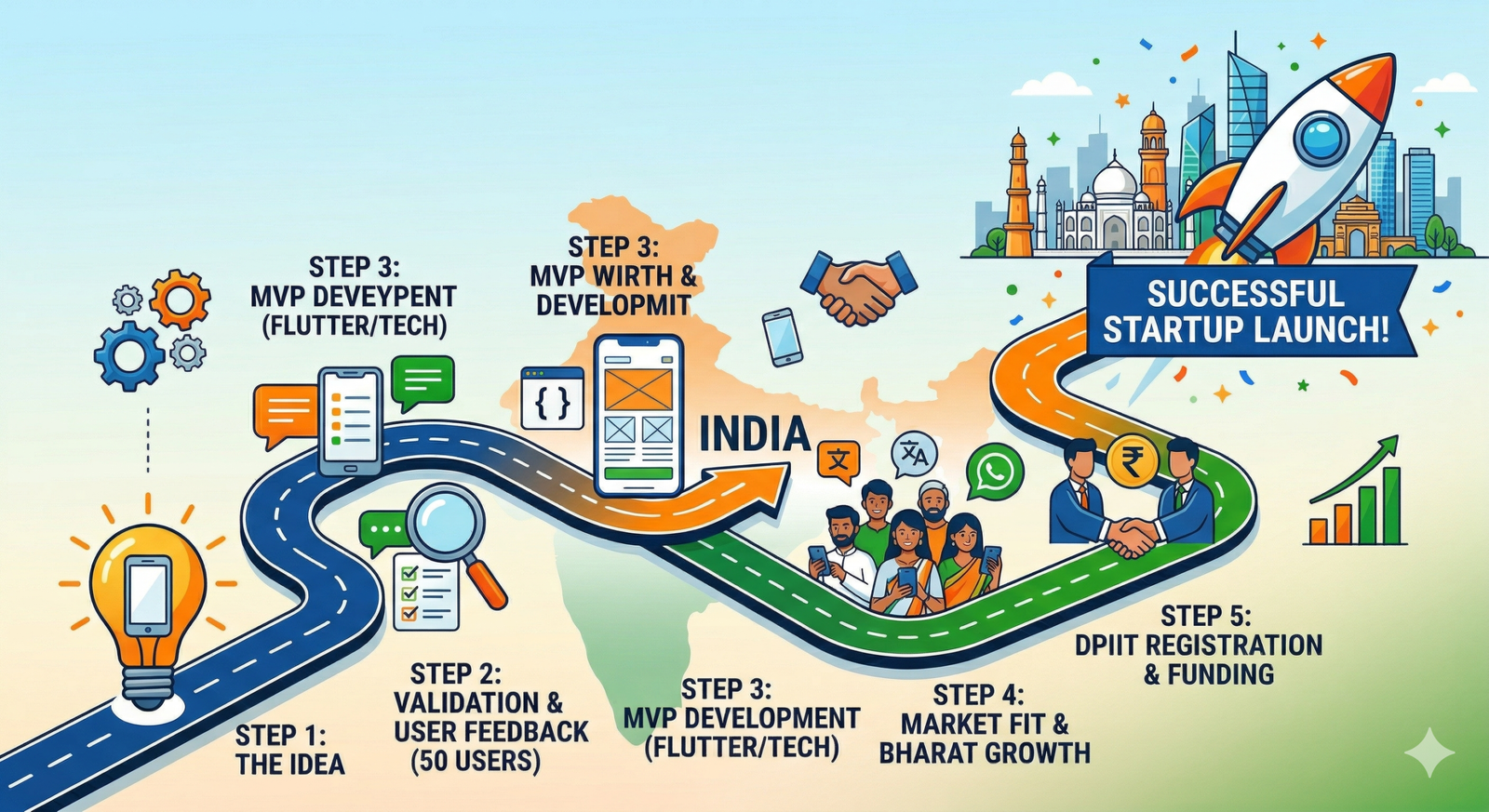
India has crossed 750 million smartphone users — and the number keeps climbing. The digital economy is booming, fintech is exploding, and every week a new startup from Tier 2 and Tier 3 cities is making headlines. If you have an app idea, 2026 might just be your best window to act.
But here’s what most guides won’t tell you: the majority of Indian app startups fail — not because the idea was bad, but because the execution was wrong. Wrong tech stack, no proper validation, zero understanding of the Indian user, or simply running out of money before finding product-market fit.
This guide covers everything — from app idea validation and app development cost in India to DPIIT registration, Flutter vs React Native comparison, app monetization strategies, seed funding India options, and a growth roadmap. Let’s start from zero.
Step 1: Understanding the Indian App Market in 2026
Before you write a single line of code, you need to understand who you are building for. The Indian market is not one market — it’s hundreds of micro-markets layered by language, income, device capability, and digital literacy.
Key Market Stats You Must Know
- Indians spend an average of 4.7 hours per day on mobile apps
- Entertainment, fintech, edtech, and hyperlocal services lead downloads
- Over 50% of new users come from Tier 2 and Tier 3 cities
- Regional language users are growing 3x faster than English-only users
- UPI transactions crossed 13 billion monthly in 2025 — fintech opportunity is massive
2026 Trends Shaping App Development in India
Super Apps: India is moving away from single-purpose apps. PhonePe started as a payments app and is now a full financial services platform. Build with expansion in mind.
Voice-First & Regional Language: Over 600 million Indian internet users prefer their local language. Apps like ShareChat proved that regional language is not a ‘nice-to-have’ — it’s a growth multiplier.
AI-Powered Features: AI tools are now accessible to small startups too. From chatbots to personalized recommendations, integrating AI in your app is more affordable than ever.
Offline-First Architecture: Network issues are still common in many parts of India. Apps that work even with poor connectivity retain users far better.
Hyperlocal & Bharat-Focused: The next 200 million users are coming from small towns. If your app can serve them, your TAM (Total Addressable Market) multiplies dramatically.
Step 2: Validate Your App Idea Before Building
This is the step most first-time founders skip — and the most expensive mistake they make. Validation does not mean asking your friends if your idea is good. It means talking to real potential users and proving that they have the problem you think they have.
How to Validate Your App Idea in India
- Talk to at least 50 target users — in-person, on WhatsApp, or via video call
- Create a simple landing page and run Rs. 500–1,000 worth of Instagram/Facebook ads to measure interest
- Use the ‘Fake Door’ method: show app mockups to users and observe how they interact
- Join niche WhatsApp groups and communities to run surveys
- Look at negative reviews of competitor apps on the Play Store — those complaints are your opportunity
Step 3: Build Your MVP — Minimum Viable Product
Your MVP is the simplest, leanest version of your app that still solves the core problem. Instagram launched with just photo filters. WhatsApp launched with just messaging. Your MVP should do ONE thing extremely well.
App Development Cost in India — What to Expect
This is one of the most-searched topics for Indian founders, and for good reason. Here’s a realistic breakdown:
| App Type | Estimated Cost (INR) | Timeline |
| Basic MVP (No-Code) | Rs. 0 – Rs. 50,000 | 2–4 weeks |
| Simple Custom App | Rs. 2–5 Lakhs | 2–3 months |
| Mid-complexity App | Rs. 8–15 Lakhs | 4–6 months |
| Full-feature App | Rs. 20–50 Lakhs+ | 6–12 months |
Flutter vs React Native India — Which Should You Choose?
This is one of the biggest technical decisions for Indian startups. Here’s the honest comparison:
Flutter: Best for startups that want a single codebase for iOS, Android, and web. Developed by Google, it offers great performance on low-end devices — ideal for the Indian market. Most Indian development agencies now prefer Flutter.
React Native: Best if your team already knows JavaScript or React. Huge community, better for apps that need deep native integrations. Facebook-backed, widely used by companies like Myntra and Flipkart.
Our Recommendation: For Indian app startups in 2026, Flutter is the better default choice — especially if you are targeting Tier 2/3 cities where device performance varies.
No-Code & Low-Code Options
If budget is a constraint, tools like FlutterFlow, Bubble, and Glide can help you build a functional MVP for near-zero cost. Many Indian founders have validated million-dollar ideas using no-code tools before hiring developers.
Step 4: Legal Setup & DPIIT Registration
Setting up your startup legally is now simpler than ever — and in many cases, FREE. Here is what you need to do:
Company Registration
- Register a Private Limited Company via the Ministry of Corporate Affairs (MCA) portal
- Cost: Rs. 10,000 – Rs. 25,000 (including professional fees)
- Timeline: 7–15 working days
- You will need: Directors’ Aadhaar/PAN, address proof, and a unique company name
DPIIT Startup Registration — Why It Matters
DPIIT (Department for Promotion of Industry and Internal Trade) startup registration is completely free and gives you serious advantages:
- Tax exemption for 3 years under Section 80-IAC
- Self-certification for 9 labour and environment laws
- Fast-track patent application with 80% rebate on fees
- Access to government tenders without prior experience
- Eligibility for Startup India Seed Fund Scheme (up to Rs. 50 Lakhs)
Intellectual Property Protection
- Trademark your company name and logo early — cost is Rs. 4,500 per class for startups
- If your app has a unique algorithm or process, explore patent filing
- Register your domain and social media handles immediately after company registration
Step 5: Find the Right Development Team
A wrong development team can kill your startup before it even launches. This is one area where Indian founders need to be especially careful.
Your Options
Technical Co-Founder: Best option if you are non-technical. A co-founder has skin in the game — they work for equity, not salary, and care about the product’s success as much as you do.
Development Agency: Good if you have a clear spec and budget. Look for agencies with at least 5 similar app projects in their portfolio. Always check references.
Freelancers: Affordable but risky for full product development. Good for specific tasks like UI design or API integration.
Full-time Hire: Makes sense only after you have validated the product and raised some funding.
Red Flags to Avoid
- Agency promises delivery in less time than is technically possible
- No previous apps similar to yours in their portfolio
- Asks for 100% payment upfront
- Cannot give references from previous clients
- No process for ongoing support and bug fixes after launch
Step 6: App Monetization India — Choose the Right Revenue Model
Choosing the wrong monetization model is one of the top reasons Indian apps fail to become sustainable businesses. Indian users are price-sensitive but they do pay — if the value is clear.
Monetization Models That Work in India
Freemium Model: Offer core features free, charge for premium. Works well for productivity, health, and business apps. Key: Free tier must be genuinely useful, not crippled.
Subscription Model: Growing rapidly in India — especially for SaaS and B2B apps. Keep monthly price realistic (Rs. 49–299 for B2C, Rs. 999–4,999 for B2B). Offer annual plans with 30–40% discount.
Commission/Transaction Fee: Works for marketplaces, fintech, and booking apps. Paytm, Swiggy, and Urban Company all use this model.
Advertisement-Based: Requires large user base (1M+ MAU) to generate meaningful revenue in India since ad rates are lower than Western markets.B2B SaaS: Often the most sustainable model for Indian startups. Businesses pay reliably. Consider targeting SMBs (Small & Medium Businesses) which are massively underserved
Step 7: Seed Funding India — How to Fund Your App Startup
Money is not your first problem — it’s your second. Your first problem is validation. But once you have traction, here’s how Indian app startups raise money:
Stage-by-Stage Funding Roadmap
Stage 1 — Bootstrapping (Rs. 0 – Rs. 10 Lakhs): Personal savings, friends & family. Focus: Build MVP and get first 100 users.
Stage 2 — Government Grants (Rs. 10–50 Lakhs): Startup India Seed Fund Scheme, iCreate, BIRAC (for deep tech), and state-level startup schemes. Apply early — process takes 3–6 months.
Stage 3 — Angel Investment (Rs. 25 Lakhs – Rs. 2 Crores): Platforms: AngelList India, LetsVenture, Indian Angel Network. Bring: traction data, clear unit economics, and a compelling pitch deck.
Stage 4 — Pre-Seed/Seed VC (Rs. 2–15 Crores): Early-stage VCs: Blume Ventures, Stellaris, Elevation Capital, Better Capital. Need: Product-market fit evidence and growing user base.
What Investors Look For in 2026
- Clear problem-solution fit with real user evidence
- Unit economics: Customer Acquisition Cost (CAC) vs Lifetime Value (LTV)
- Founder’s domain expertise and resilience
- Market size — is this a Rs. 1,000 Crore+ opportunity?
- Early revenue or strong retention metrics
Step 8: Performance Optimization for the Indian Market
Building an app that works flawlessly on a Rs. 8,000 Redmi phone with a 2G connection in rural UP — that’s the real test of an Indian app. Here’s how to optimize:
Technical Optimizations
- App size: Keep APK under 20MB for first install. Use Android App Bundle for dynamic delivery
- Images: Use WebP format, lazy loading, and CDN for fast delivery
- Offline mode: Cache critical data locally so the app works without internet
- Battery optimization: Minimize background processes and wake locks
- Low-end device testing: Always test on Rs. 6,000–10,000 range smartphones
UX Optimizations for India
- Add regional language support from day one — even just Hindi + 2 regional languages can double your reach
- Use voice input options wherever possible — many users prefer speaking over typing
- Keep UI simple — if a 45-year-old first-time smartphone user cannot navigate your app, simplify it
- Support UPI natively for payments — credit/debit card usage is far lower in Tier 2/3 cities
Step 9: Marketing & User Acquisition for Indian Apps
Building the app is 50% of the work. Getting people to use it is the other 50%. Indian user acquisition has its own playbook.
App Store Optimization (ASO) — Your Free Growth Channel
- Use high-volume keywords in your app title and description (research with Google Play Console)
- Add screenshots in multiple regional languages
- Aim for 4.2+ star rating — aggressively ask happy users to leave reviews
- Respond to every negative review within 24 hours
Digital Marketing Channels That Work in India
WhatsApp: The most underrated marketing channel. Build a community. Share updates. Run referral campaigns. WhatsApp has 500M+ users in India and 95%+ open rates.
Instagram & YouTube Reels: For B2C apps, short-form video content is the most cost-effective way to acquire users in India. Tutorials, success stories, and behind-the-scenes content work well.
Micro-Influencers: Influencers with 10,000–100,000 followers in a specific niche drive better ROI than mega-celebrities. A finance influencer with 50K engaged followers will outperform a Bollywood celebrity for a fintech app.
LinkedIn: For B2B apps, LinkedIn is the most effective channel. Post thought leadership content, not just product promotions.
Referral Programs: Paytm’s cashback model and Meesho’s referral program are legendary. Build a referral loop into your app from day one.
Step 10: Scale, Retain & Grow
Getting your first 1,000 users is hard. Getting from 1,000 to 100,000 is even harder. Here’s how to scale sustainably:
Key Metrics to Track
- DAU/MAU Ratio: Measures stickiness. Above 20% is good, above 40% is excellent
- Retention Rate: What % of users come back after Day 1, Day 7, Day 30?
- Customer Acquisition Cost (CAC): How much are you spending to acquire each user?
- LTV: Lifetime Value of a user — must be at least 3x your CAC
- NPS (Net Promoter Score): Are users recommending your app to others?
Scaling Beyond India
Once you have solid traction in India, consider markets with similar user behavior: Bangladesh, Sri Lanka, Indonesia, and Nigeria. Many Indian app startups have found it easier to expand to these markets than to crack the US or European market.
Frequently Asked Questions (FAQs)
These are the most-searched questions by Indian app founders in 2026:
- Q1: How much does it cost to build an app in India?
App development cost in India varies significantly based on complexity. A basic MVP using no-code tools can be built for near-zero cost. A simple custom app typically costs Rs. 2–5 Lakhs, a mid-complexity app with backend costs Rs. 8–15 Lakhs, and a full-featured product can go up to Rs. 50 Lakhs or more. The key is to start with an MVP and validate before investing in full development.
- Q2: How do I register a startup in India?
First, register your company as a Private Limited Company through the MCA portal. Then apply for DPIIT Startup Recognition at startupindia.gov.in — it’s free and takes about 30 minutes. DPIIT recognition gives you tax benefits, patent fee rebates, and access to government seed funding schemes.
- Q3: Flutter vs React Native — which is better for Indian startups?
For most Indian startups in 2026, Flutter is the recommended choice. It offers excellent performance on low-end devices (critical for India’s diverse device market), a single codebase for iOS and Android, and growing community support. React Native is better if your team is JavaScript-first or if you need deep native integrations.
- Q4: How do I get seed funding for my app startup in India?
The typical path is: bootstrap to MVP, apply for government grants (Startup India Seed Fund offers up to Rs. 50 Lakhs), then approach angel investors via platforms like AngelList India or LetsVenture once you have traction. VCs like Blume, Stellaris, and Elevation Capital fund at the pre-seed/seed stage.
- Q5: What is the best app monetization strategy for India?
For B2C apps, a freemium model with a well-designed subscription tier works best. For B2B, SaaS subscription pricing is most reliable. Avoid relying purely on ad revenue unless you have millions of active users. Transaction fees work well for marketplace and fintech apps. Always keep Indian price sensitivity in mind when setting your pricing.
Conclusion: Your App Idea Is a Business in Waiting
India’s app market in 2026 is both exciting and ruthlessly competitive. The opportunity is real — 750 million smartphone users, a booming digital economy, and government support that has never been stronger. But the gap between a good idea and a successful business is wider than most founders expect.
Here is what separates app startups that succeed from those that don’t: successful founders validate before they build, choose their tech stack based on their users (not trends), set up their legal and financial foundation early, monetize with India’s price sensitivity in mind, and — most importantly — they don’t give up after the first setback.
The Indian startup ecosystem rewards founders who are persistent, adaptable, and deeply understand their users. Whether you are building for farmers in Maharashtra, students in Bihar, or businesses in Bangalore — if you solve a real problem and execute with discipline, your app startup has every chance of succeeding.
The best time to start was yesterday. The second best time is today.
Now, Over to You: Let’s Build Your Digital Reality
Building a startup is a massive undertaking, but you don’t have to navigate it alone. At ZenJourney, we specialize in transforming ideas into digital reality through a strategy-first process. From our initial discovery call to delivering a high-quality custom app in under 8 weeks, we partner with you every step of the way.
We want to hear from you:
- What stage is your startup at right now? Are you still in the discovery phase defining your roadmap, or are you ready to build your MVP?
- What is your biggest roadblock? Is it the high cost of development? (Check out our ₹34,999 Startup Plan which includes a native app and Play Store publishing).
- Are you looking for long-term growth? Do you need continuous technical support or a SaaS franchise model to scale your business?
Drop your biggest challenge in the comments below! The team at ZenJourney is ready to help you brainstorm solutions and elevate your business globally.
Found this guide helpful? Share it with a fellow founder, and let’s build the next big thing for Bharat together!
Leave a Reply